
What is Passive House?
Passive House is the world's leading standard for comfortable, healthy, energy-efficient homes. Focusing on a super-insulated and airtight building envelope, it cuts heating and cooling energy to a fraction of what a conventional home consumes and delivers continuously filtered indoor air to keep out smoke, pollen, and pollutants.
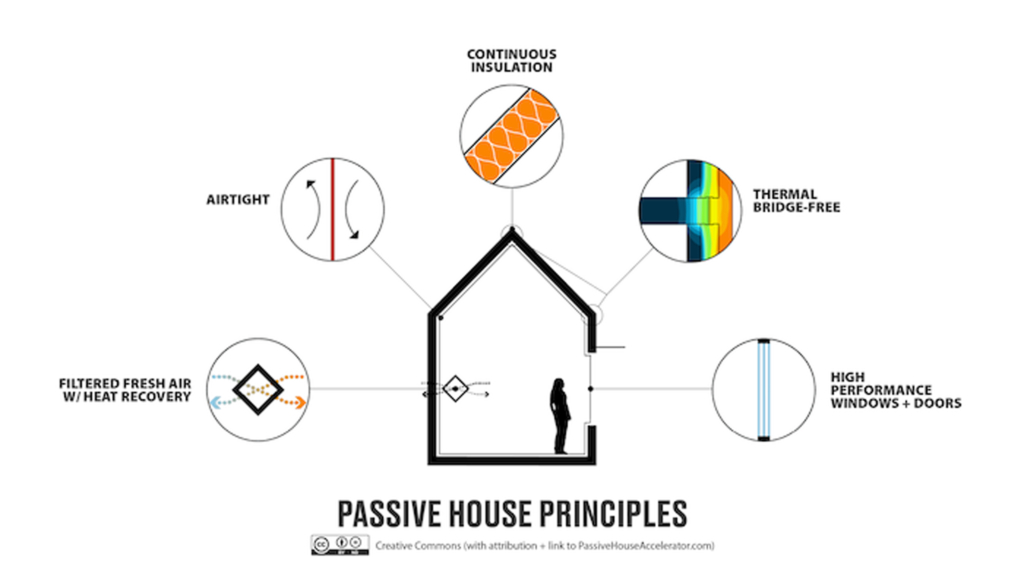
This is achieved through five key design principles:
• Continuous Insulation. A thick, uninterrupted layer of insulation wraps the walls, roof, and foundation, eliminating weak points where heat escapes in winter or enters in summer to keep indoor temperatures consistent.
• Airtight Construction. A carefully sealed building envelope prevents unwanted air leakage, eliminating drafts while keeping dust, pollen, smoke, and moisture outside.
• High-performance Windows. Triple-pane glazing and insulated frames reduce heat loss in winter and solar heat gain in summer. Window size and placement are carefully tuned to the home’s orientation to make the most of the sun year-round.
• Eliminating Thermal Bridges. Structural details are carefully designed to prevent heat from bypassing the insulation—thereby reducing cold spots, condensation, and the potential for mold.
• Balanced Ventilation with Heat Recovery. A mechanical ventilation system continuously supplies filtered fresh air while exhausting stale air. A heat recovery ventilator (HRV) transfers much of the heating or cooling energy from the outgoing air to the incoming air, keeping the home comfortable and efficient year-round.
Each principle improves performance independently. Working together, they create a home that's quieter, healthier, more comfortable, and far more energy-efficient than code-built construction.
Passive House Explained:
A Guide for Denver and Front Range Homeowners

Why Passive Makes Sense in Colorado
Denver and the Front Range present conditions that strain a conventional home's envelope year-round: cold winters, hot summer afternoons, intense sun, low humidity, and large day-to-night temperature swings. These conditions expose every weak point in insulation, glazing, and air sealing—and a home that wasn't designed to address them pays for it in high bills, uneven temperatures, and comfort problems many homeowners accept as normal.
Passive House homes respond to all of these issues, in ways you feel directly. Indoor temperatures stay consistent, eliminating cold floors, drafty rooms, and uncomfortable spaces. Triple-pane windows stay comfortable to sit beside even on the coldest days, and the thick envelope and airtight construction reduce exterior noise, keeping interiors quieter than a code-built home.
Cleaner Indoor Air
Wildfire smoke, ozone alerts, and high pollen counts are common events here, but most conventional homes offer little protection: gaps around windows, doors, and framing continuously pull polluted outdoor air inside, even when windows are closed.
A Passive House's airtight construction eliminates those gaps, and the balanced mechanical ventilation system continuously supplies filtered fresh air while exhausting stale indoor air, so the air inside stays clean even during smoke events and high-pollen days.
Wildfires + Power Outages
Homes in Denver and across the Front Range are increasingly exposed to wildfire smoke events and grid strain during extreme weather. During a wildfire, the airtight envelope that blocks uncontrolled air leakage in normal use also blocks wind-driven embers from entering the home, and the continuously filtered mechanical ventilation keeps smoke from entering even when outdoor air quality is hazardous. Triple-pane windows, already specified for thermal performance, are more resistant to heat-induced shattering than standard glazing, removing one of the more common paths fire finds into a home.
During a power outage, that same insulated, airtight envelope means the home holds safe, livable temperatures far longer than a code-built home can manage, losing heat very slowly in winter and gaining it slowly in summer.
Energy Savings
Certified Passive House buildings reduce space heating and cooling energy by 50 to 90 percent compared to typical existing homes. Lower energy use translates directly to lower operating costs, year after year, and those savings compound as energy costs rise.
Pairing a Passive House with even a modest solar array is often enough to reach net-positive energy, where the house generates more than it consumes. With Xcel's net metering program, excess energy is banked for lower-production months when it's needed.
Can Any House be a Passive House?
Yes. Both new homes and existing homes can be designed or renovated to meet Passive House standards, although the approach differs for each project.
To be considered a Passive House, a building must undergo a certification process to ensure it meets the standards established by the Passive House Institute. Certification is performance-based, meaning a home must meet rigorous energy, comfort, and air quality targets—not simply incorporate a prescribed list of products or construction methods. During construction, the project undergoes quality assurance measures, including one or more blower-door tests to verify airtightness. Once complete, an independent certifier reviews the energy model, construction documentation, and test results before awarding certification.
There are several certification levels to suit different project goals. Passive House Classic is the baseline certification, while Plus and Premium recognize homes that generate increasing amounts of renewable energy, typically through rooftop solar.
Passive House vs. Net-Zero: What's the Difference?
Net-Zero is another sustainability-minded building standard that’s often mentioned alongside Passive House. While the two overlap, they focus on different goals. Passive House minimizes a home’s energy demand through the building’s design—a conservation-first approach. Net-Zero focuses on balancing annual energy use by generating as much renewable energy as the home consumes, typically through rooftop solar.
The strength of Passive House is that it improves the home in ways beyond just energy efficiency. Superior insulation, airtight construction, high-performance windows, and balanced ventilation create a home that’s quieter, healthier, more comfortable, and far less expensive to heat and cool. Achieving full certification, however, requires careful design, rigorous detailing, and quality assurance throughout the design and construction process.
Net-Zero offers a different benefit: dramatically lower—or even zero—annual energy bills. While Net-Zero homes are generally designed to be highly energy efficient, the standard measures energy balance rather than prescribing a specific path to achieve it, giving designers greater flexibility in how efficiency measures and renewable energy systems are combined.
Rather than competing approaches, Passive House and Net-Zero work exceptionally well together. By dramatically reducing a home’s energy demand first, Passive House makes it possible to achieve Net-Zero with a smaller renewable energy system. That’s why Passive House is often considered the ideal foundation for a Net-Zero home.
Passive House FAQs
Does Passive House Limit Design?
Not at all. Passive House is a performance standard, not an architectural style. Whether your vision is warm modern, mountain contemporary, or something more traditional, Passive House principles can be integrated without compromising design.
Can I Open the Windows?
Absolutely. Passive House homes don't trap stale air or prevent you from opening windows—they simply eliminate uncontrolled air leakage. Fresh, filtered air is continuously supplied through a balanced ventilation system, so you can open the windows whenever you want, but you no longer need to rely on them for healthy indoor air.
Is Passive House Worth the Cost?
Building to full Passive House certification generally costs more than conventional construction — typically 5 to 15 percent above a code-built home, depending on project size, site conditions, and how early performance goals are integrated into the design. Typically, more of the budget goes toward insulation, windows, and airtightness taping/sealing in a Passive project, though the simplified mechanical systems needed for those projects partially offset the increase.
However, focusing only on upfront cost misses the bigger picture. What you get in return is a home that's quieter, healthier, more comfortable, less expensive to operate, and with fewer drafts, less condensation, more consistent temperatures, and greater resilience during extreme weather.
Some homeowners also choose to incorporate Passive House principles without pursuing formal certification, achieving many of the same benefits while maintaining greater flexibility in budget and design.
Are There Advantages to Formal Passive House Certification?
That depends on your project goals, but here are some benefits of formal certification:
• Tax Incentives. Federal energy tax credits, utility rebates, and other incentive programs apply to qualifying Passive House projects and can help offset the cost of certification.
• Appraisal + Resale. Certified high-performance homes increasingly command higher appraisal values and sell faster, as buyers value energy efficiency and predictable operating costs.
• Long-Term Protection. As energy codes tighten and utility costs rise, homes built to Passive House standards are well-positioned to meet future requirements without expensive retrofits.
For some homeowners, certification is the goal. For others, incorporating Passive House principles without certification provides the right balance of performance, flexibility, and cost.

Design or Performance: You Don't Have to Choose
Passive House demands a deep understanding of building science—from building orientation and window placement to airtight construction, insulation strategies, and mechanical systems. It’s easy to think of building performance and architectural design as separate disciplines. In reality, they’re deeply connected.
Passive House isn’t something applied to a finished design—it’s woven into the architecture itself. Decisions about building orientation and window placement influence solar gain and shading, while also determining where living spaces receive morning light or frame expansive views. Roof forms, overhangs, and exterior shading respond to both the character of the home and Colorado’s seasonal sun. Considering these decisions through both an architectural and performance lens results in homes that are more comfortable, more efficient, and more deeply connected to their site.
We’re a Certified Passive House Designer (CPHD) because it deepens our understanding of how thoughtful architecture can support the people who live in it. It allows us to design homes that are healthier, quieter, more comfortable, more resilient, and more energy efficient—regardless of whether a project ultimately seeks certification. Our expertise lies in integrating Passive House principles into refined modern architecture—homes where high performance is built into the design from the beginning. See how LTBa integrates Passive House into residential design.
Interested in incorporating Passive House principles into your project? We’d be happy to talk through what’s possible.